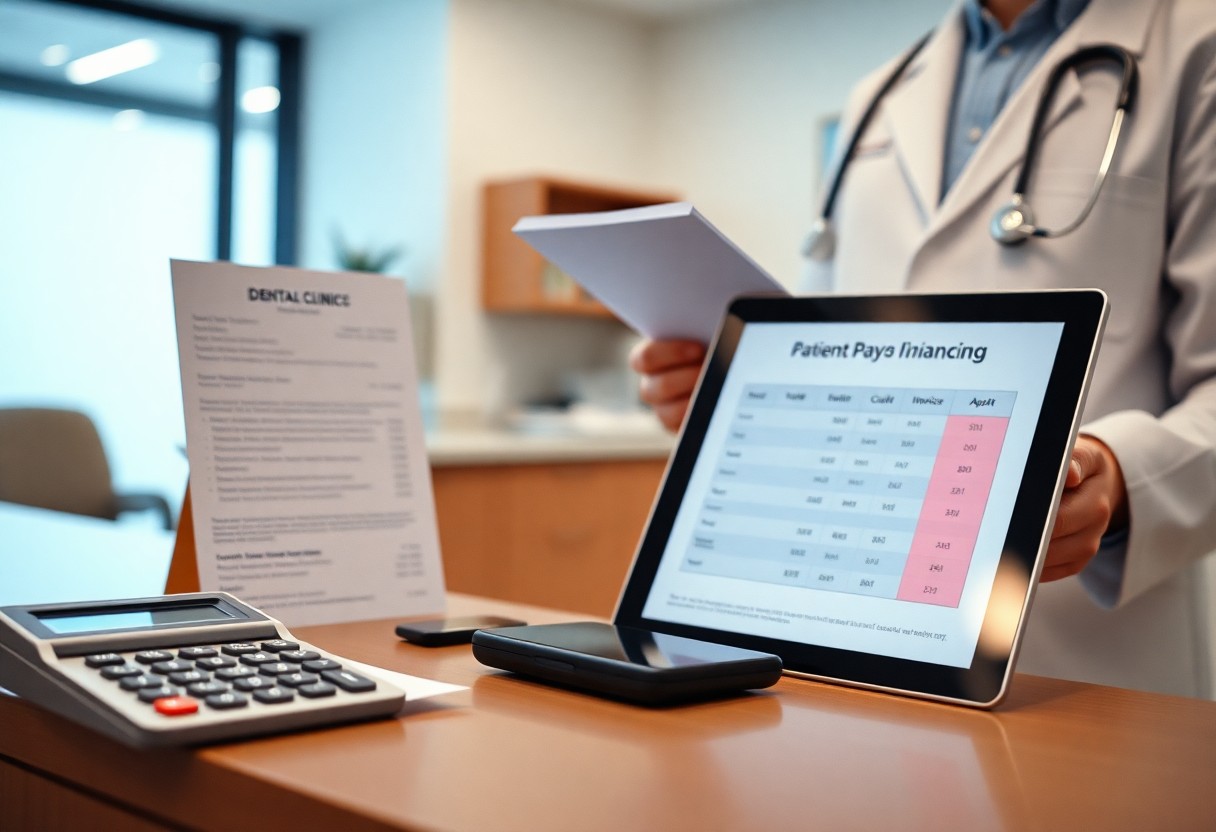
Overcoming unexpected dental bills starts with a clear plan: you can manage your out-of-pocket costs by using strategic patient financing to spread payments, prioritize care, and avoid delaying treatment for unexpected high-cost procedures that can worsen oral health; by comparing plans and negotiating fees you can reduce immediate financial strain while ensuring timely care.
Understanding Out-of-Pocket Dental Expenses
You'll encounter both predictable and surprise charges when insurance leaves gaps: routine cleanings typically run $75-$200, fillings $150-$450, crowns $800-$2,500, and implants often cost $3,000-$6,000. You should also plan for diagnostic imaging, lab fees, and specialist premiums that can add several hundred to several thousand dollars to your bill.
Key Factors Contributing to Dental Costs
Your bill reflects multiple drivers:
Procedure type - complexity and materials usedInsurance coverage - deductibles, annual maximums, exclusionsProvider experience - specialists charge more than generalistsGeographic location - urban vs. rural fee differentialsDiagnostic needs - CBCT, labs, or referrals increase totalsThe interplay of these elements explains why identical treatments can vary widely in price for different patients.
Importance of Patient Financing Options
Offering structured financing reduces upfront barriers: practices that present 6-12 month 0% plans or low-interest loans typically see treatment acceptance rise by 20-35%; you can also use HSAs for eligible work or split payments among family members to keep care timely and affordable.
In practice, choose between in-house plans that preserve revenue and third-party lenders (CareCredit, LendingClub) that provide fast approvals-note third-party APRs often range from 6-26% APR, while promotional 0% offers are time-limited. You should prioritize transparent monthly payment examples for patients, pre-qualify options to speed consent, and track acceptance metrics so your financing mix improves both access and clinic cash flow.
How to Assess Your Dental Financing Needs
Start by inventorying procedures, timelines and insurance limits: list costs (example: fillings $100-$250, crowns $800-$1,500, implants $3,000-$5,000), expected dates, and any deductible or waiting periods. Compare that to your cash flow, emergency fund and available credit; you may need short-term 0% APR offers for $500-$2,000 treatments or longer loans for >$3,000 work. Prioritize urgent infections (delay increases risk and cost) and tag items you can stage over months.
Evaluating Your Current Financial Situation
Calculate your monthly take-home pay, dental savings and outstanding debts; target a debt-to-income ratio under 36%. Check your credit score-scores above 750 often qualify for 0% APR promotions, while scores below 640 can push rates past 15%. Factor in upcoming bills and a recommended three-month emergency cushion before committing to multi‑month financing.
Identifying Necessary Dental Procedures
Get an itemized estimate and a staged treatment plan from your dentist; insurers typically cover preventive 80-100%, basic 50-80%, and major ~50% after deductibles. Expect cost ranges like fillings $100-$250, root canals $700-$1,200, crowns $800-$1,500, implants $3,000-$5,000. Delaying a root canal can escalate to extraction and a higher total bill.
If you face a molar implant ($3,500) plus a crown ($1,000) the $4,500 total with 30% insurance leaves $3,150. You could take a 12‑month 0% promotional plan and pay $262.50/month, avoiding a high‑interest personal loan (typical 8-24% APR). Consider staging elective work, using in‑office plans for smaller balances, and choosing longer terms only for costs above $2,000.
Tips for Choosing the Right Patient Financing Plan
Focus on aligning term length with your treatment timeline, weighing total repayment against monthly affordability, and confirming lender reputation and customer service. Check for promotional APRs, origination fees, and whether the plan covers the full treatment or leaves out-of-pocket dental costs to you. After you compare total cost, fees, and service transparency, pick the option that minimizes what you pay overall while keeping monthly payments manageable.
- Patient financing: prioritize lenders with clear contracts and quick approvals
- Interest rates: compare APRs and promotional terms across 3-5 offers
- Out-of-pocket dental costs: confirm what portion the plan covers vs. your balance
- Repayment terms: shorter terms lower interest but raise monthly payments
Comparing Interest Rates and Terms
Scan APRs from 0% promotional up to 25-30% for riskier plans, and compare term lengths from 6 to 60 months. Watch for deferred-interest offers: they can apply interest retroactively if you miss the promo window. Use examples: a $3,000 treatment at 12% APR over 36 months costs about $317/month and ~$378 interest, while a 0% for 12 months may cost more if deferred interest applies.
Rate and Term Comparison APR / Promotional Terms 0% promo vs. standard APR; impacts total interest paid Term Length (months) Shorter = less interest, higher monthly; longer = lower monthly, more interest Minimum Payments Low minimums can extend payoff and increase interest costs Deferred Interest Clauses Danger: missed payments can trigger retroactive interest
Understanding Fees and Additional Costs
Expect origination fees (commonly 1-5% or $25-$300), routine late fees ($25-$40), and occasional prepayment penalties; these add to your effective cost. Ask for a full fee schedule, and compare total financed amount plus fees to see the real price you'll pay.
For example, a 3% origination fee on a $3,000 plan adds $90 up front; a single $35 late fee and returned-payment charge can quickly erode savings from a low APR. You should request written disclosures for all fees, confirm whether interest accrues during promotional periods, and run a total-cost calculation (principal + fees + projected interest) before signing. Prioritize plans that waive origination or prepayment penalties and clearly state fee triggers to avoid surprises.
How to Maximize Insurance Benefits
To squeeze more value from your plan, audit benefits before scheduling treatment and time procedures around coverage windows. Many dental plans have an annual maximum of $1,000-$1,500, cover preventive care at 80-100% but major work often at ~50% with 6-12 month waiting periods. For instance, if you've used $1,000 of a $1,500 max, a $1,200 crown may leave $500 in benefits and $700 out‑of‑pocket, so align expensive work with a fresh plan year when feasible.
Knowing Your Coverage Limits
Pull your summary of benefits to confirm the annual maximum, deductible, frequency limits (commonly two cleanings per year), and network restrictions. Many plans allow bitewing X‑rays every 12-36 months and impose a 5-7 year replacement rule on crowns. Use these specifics to split multi‑stage treatment across years, file preauthorizations, and avoid unexpected denials.
Utilizing Flexible Spending Accounts (FSAs)
Use an FSA to pay dental expenses with pre‑tax dollars-eligible items include braces, crowns, implants, and routine care. Annual contribution limits hover around $3,000, so funding expected procedures can reduce your net cost by roughly 20-30% via tax savings. Verify eligible expenses and whether your employer offers a carryover or grace period before relying on FSA funds.
Estimate needs during open enrollment: if you expect a $2,000 implant, contribute that amount to avoid financing interest. Save receipts and submit claims promptly since substantiation is often required. Also check whether your employer permits a $610 carryover or a short grace period-those options determine how aggressively you can allocate pre‑tax dollars without risking forfeiture.
Strategies for Effective Budgeting for Dental Costs
Map upcoming procedures against your monthly budget: list dates and expected costs (cleanings $75-$300, root canals $700-$1,500, crowns $800-$2,000) and prioritize urgent work first. If you spot a gap, shift discretionary spending or use an HSA/FSA for tax-advantaged savings; using pre-tax accounts can cut your out-of-pocket by 10-30%. Schedule major elective work across quarters to smooth payments and avoid stacking high-interest credit on multiple treatments.
Creating a Realistic Payment Plan
Divide the total treatment cost by a manageable term: for example, $2,400 over 12 months = $200/month, or choose 24 months at low APR to lower monthly strain while tracking total interest. Compare plans by APR and fees, and watch for deferred-interest traps where missed payments trigger back interest. You should get the payment schedule in writing and run the numbers with your household cash flow before committing.
Setting Aside Emergency Funds
Target a dental emergency buffer of about $500-$2,500 depending on your risk: extractions and urgent care can run $150-$800, while an implant starts near $1,500. Put this money in an easy-access account so you can pay promptly and avoid costly last-minute financing; having $1,000 available often prevents high-interest borrowing.
Automate transfers-$50-$100/month will build a $600-$1,200 cushion in a year. Keep the fund separate, replenish immediately after use, and pair it with a slimline credit backup (0% intro APR offers only if you can repay within the term). Prioritize this buffer over nonimperative elective upgrades to minimize financial disruption from sudden dental needs.
Tips for Communicating with Your Dentist
When you prepare for appointments, ask for an itemized estimate and clarify which codes apply so you can compare insurance, out-of-pocket exposure, and patient financing options; request written cost breakdowns for major procedures like crowns or implants to avoid surprises. Use clear budget figures-what you can pay monthly-and ask about staged treatment or cheaper interim solutions. This keeps discussions focused on both clinical need and your financial limits.
- Request an itemized estimate with procedure codes and expected dates
- Ask about in-house payment plans and third-party patient financing
- Verify what your insurance will cover before scheduling
- Propose phased treatment to spread costs over months
- Confirm any interest rates, deferred-interest periods, or fees in writing
Discussing Financial Concerns Openly
When you bring up money, give a concise budget range-say $100-$300 per month-and ask the office to map treatment phases to that cadence; request alternatives if a single solution costs $1,500-$4,000 upfront. Ask whether they offer sliding-scale fees, charity programs, or estimates for lower-cost materials. This straightforward approach reduces awkwardness and helps your dentist design a plan that fits your finances.
Exploring Alternative Treatment Options
You can often trade higher upfront cost options for lower-cost alternatives that preserve function and aesthetics-for example, an implant ($3,000-$6,000) versus a bridge ($1,200-$2,500) or a removable partial denture ($500-$1,500); discuss lifespan, maintenance, and insurance contribution for each. Compare expected longevity and potential future expenses so you weigh short-term savings against long-term value.
For more depth, ask your dentist to show case examples: a patient who deferred an implant and chose a bridge saved roughly $2,000 initially but planned for a replacement in 10-15 years; another who chose a partial denture paid $900 and adjusted it twice over five years, avoiding short-term debt. Evaluate clinical trade-offs-bone preservation with implants versus lower immediate cost-and verify whether staged care plus patient financing spreads payments affordably without high interest.ConclusionUltimately you can control out-of-pocket dental costs by proactively discussing payment options with your provider, comparing patient financing and interest terms, using HSAs/FSAs when available, prioritizing necessary treatments, and setting realistic payment plans. Track expenses, verify billing, and choose reputable lenders to protect your credit. With planning and clear communication you'll reduce financial surprise and spread costs into manageable monthly payments.