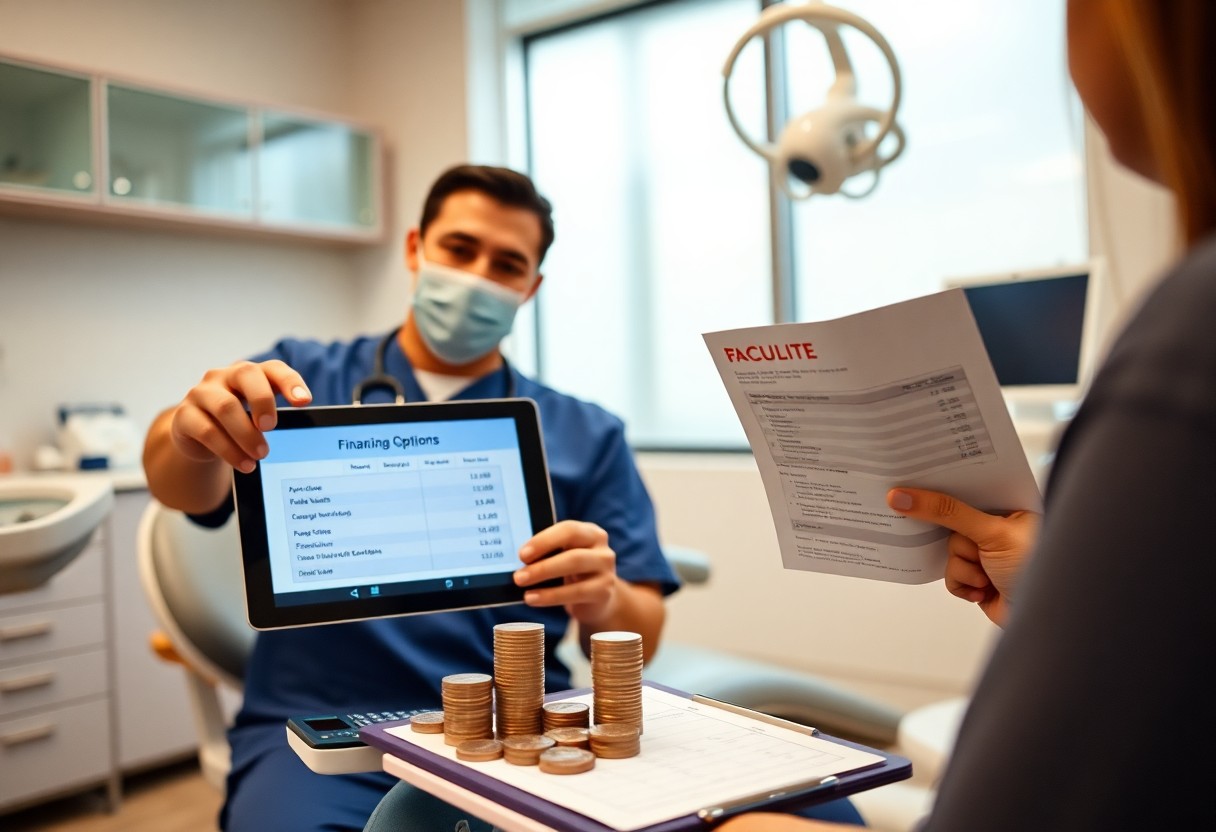
With so much misinformation about dental financing, you may delay care due to fear of hidden costs or misconceptions about eligibility; this guide lets you separate dangerous myths from facts so you can seize affordable options, understand transparent terms, and protect your financial well‑being while getting the treatment you need.
Understanding Dental Patient Financing
What is Dental Patient Financing?
You use dental patient financing to split costly procedures into manageable payments so your care isn't delayed; many patients choose plans for crowns, implants, or orthodontics. Typical options let you pay over 3-60 months, with some plans offering 0% promotional APR for a set term while others carry variable APRs up to 29%. Case reviews show a 40% increase in treatment acceptance when flexible payment options are offered.
- Payment plans - short-term, often interest-free for 3-12 months.
- Third-party lenders - examples include CareCredit with promotional offers and extended terms.
- Recognizing dental patient financing increases access to recommended treatments and reduces upfront burden.
DefinitionShort-term or long-term plans to cover dental treatment costs Who uses itUninsured patients or those with high deductibles Typical terms3-60 months; 0% promotional to ~29% APR Common providersIn-house plans, CareCredit, personal loans When helpfulCosmetic work, implants, extensive restorative care
Types of Financing Options Available
You can choose in-house financing, medical credit cards like CareCredit, personal loans, dental savings plans, or use standard insurance. In-house plans often provide 0% interest for short terms; CareCredit commonly offers promotional 0% APR for 6-24 months with longer paid plans up to 60 months. Data shows clinics offering multiple options see higher treatment uptake.
Across options, in-house plans give the fastest approval and lowest friction, while third-party cards and personal loans extend borrowing capacity: personal loans may have fixed APRs around 6-36% depending on credit, and CareCredit promotions can make a $4,000 implant more affordable with deferred-interest offers. Comparing total cost, fees, and repayment speed helps you choose the best fit.
- In-house financing - quick approval, often interest-free short terms.
- CareCredit/medical cards - promotional 0% offers, up to 60 months on longer plans.
- Personal loans - fixed terms, APR typically 6-36%, useful for larger balances.
- Dental savings plans - annual fee in exchange for discounted services.
- Recognizing types of financing helps you match terms to treatment timelines and budget.
In-house financingFast approval; often 0% for 3-12 months CareCredit/medical cardsPromotional 0% APR offers; extended plans up to 60 months Personal loansFixed APR (~6-36%); lump-sum funding for large procedures Dental savings plansAnnual fee (e.g., $100-$300) for reduced fees on common services InsuranceCovers preventive and some restorative work; typically 50-80% for major procedures
Common Myths about Dental Financing
Myth 1: Dental Financing is Only for Low-Income Patients
You don't have to be low-income to use dental financing. Many patients with steady incomes use plans for implants, crowns, or orthodontics; practices offer in-house plans or third-party lenders that approve applicants with credit scores around 600+. Monthly payments commonly range from $50-$300 depending on the procedure, so financing is often a cash-flow tool that lets you prioritize oral health without depleting savings.
Myth 2: Financing Plans Always Have High-Interest Rates
You won't always face steep rates when financing dental care. Many lenders and dental offices provide 0% APR promotions for 6-18 months, or fixed-rate plans in the mid-single digits to low teens (roughly 6-12% APR). By comparing total cost and promotional terms, you can split a $2,500 procedure into manageable payments with minimal added expense.
Read terms carefully: deferred-interest plans can look like 0% but may retroactively apply interest if you fail to pay the promo balance on time. That penalty often reaches 20-29% APR, so a $2,500 balance not cleared within a 12-month promo could add roughly $500-$700 in back interest. Ask about fees, prepayment rules, and consider fixed-rate offers or automatic payments to avoid that costly outcome.
Benefits of Dental Patient Financing
By reducing the upfront cost barrier, financing lets you accept recommended treatments promptly rather than delaying care. Surveys show roughly half to two-thirds of adults postpone dental work because of cost, and delaying care can lead to infection, tooth loss, or much higher future bills. With manageable monthly payments, you can prioritize preventive visits and choose higher-quality restorative options when needed.
Flexibility in Payment Options
Different plans let you tailor payments to your budget: many providers advertise 0% interest for 6-24 months or low APR terms for 36-60 months. You can select down payments, adjust term length, and set monthly amounts-so a $1,500 root canal can be split into 12 payments of $125, keeping your cash flow steady while you get care.
Improving Access to Necessary Dental Care
When financing is offered, you can move forward with preventive and restorative procedures instead of deferring them; implants typically cost $3,000-$5,000 and crowns $800-$1,500, amounts many patients finance. Dental practices often report treatment acceptance rises 20-50% with financing available, and that matters because postponing care increases the chance of tooth loss.
For example, a $4,200 implant financed over 36 months at 6% APR results in payments around $128/month, making advanced treatments affordable. Approvals are frequently fast-often within minutes-and some programs use soft credit checks, so you can secure care quickly and avoid emergency extractions or escalating costs that follow untreated problems.
How to Choose the Right Financing Option
Factors to Consider
You should weigh the interest rate, loan length, and any upfront fees because a low monthly payment can mask a higher total cost. Many plans include deferred interest, origination charges, or annual fees; ask for the APR and the full amount payable over the term. Compare in-house offers, third-party lenders, and credit cards-short 6-12 month 0% promos differ from 24-60 month fixed-rate loans. This helps you compare true cost across options.
- APR
- Monthly payment
- Loan term
- Deferred interest
- Upfront fees
Questions to Ask Your Dentist
Request an itemized estimate listing all components-consultation, materials, lab, anesthesia-and ask whether quoted prices include follow-up visits; implant cases often range from $3,000-$6,000 per tooth. Probe whether the office offers 0% APR promotions for 6-12 months, what credit checks are required, and whether payment plans have prepayment penalties. This gives you clarity on immediate costs and long-term obligations.
Also ask about the office's policy for missed payments, typical late fees (often $25-$50), and whether financing affects scheduling or treatment timelines. For example, confirm whether a quoted bridge price includes the provisional, final crown, and lab fees so you avoid surprise charges; many patients find asking for a sample contract and a comparison of total cost over 12, 24, and 36 months reveals the best option for their budget.Misconceptions About the Application ProcessMany myths inflate the difficulty of applying for dental financing; in practice, applications are often streamlined and digital. You typically complete a short form with basic details - name, ID, income - and get a decision fast. Providers report that most applicants receive a decision within minutes for point-of-sale plans, though some cases require manual review. Missing documentation or billing setup at the practice can be the real bottleneck that delays your start.
Myth 3: The Application Process is Complicated
It isn't usually a multi-step ordeal; you can fill most applications in under 10 minutes on a tablet or phone. Many lenders use soft credit checks for prequalification so your score isn't affected, and instant approvals are common for straightforward profiles. When verification is needed, practices often ask for a photo ID and recent pay stub - once supplied, approval typically follows within 24-48 hours.
Reality of Approval Timelines
Approval timelines range from seconds to a few days depending on the lender and documentation required. Instant decisions happen in under two minutes for many point-of-sale options, while cases needing manual underwriting or additional proof can take 24-72 hours. Be aware that accepting terms may trigger a hard credit pull on some plans, which can affect your score.
Factors that extend timelines include high treatment costs, complex credit histories, or missing documents; for example, if the practice must verify employment you might wait 48 hours. Conversely, when you provide ID, proof of income, and a signed treatment plan at intake, approvals often clear in minutes. Emergency cases are sometimes expedited by the office coordinating directly with the lender.
Real-Life Experiences with Dental Financing
Several patients who delayed care used financing to get immediate treatment; you can see both benefits and pitfalls. One 24-month case reduced upfront burden with affordable monthly payments, while another faced retroactive interest after missing one payment. You should weigh total cost, promotional terms, and your ability to make on-time payments to avoid unexpected financial risk and secure better long-term oral health.
Case Studies and Testimonials
Below are concrete examples showing how different dental financing arrangements change outcomes; you can use these data points to compare plans and ask targeted questions of your provider.
- 1) Patient A - $1,200 crown via a 12‑month 0% payment plan: monthly payment $100, total cost $1,200, avoided $108 in interest versus a 9% APR option.
- 2) Patient B - $18,000 implants at 6.5% APR over 60 months: monthly payment ≈ $371, total paid ≈ $22,260, interest ≈ $4,260; on-time payments raised their credit score by ~20 points.
- 3) Patient C - $900 emergency root canal on promotional 18‑month 0% plan: missed one payment triggered retroactive interest at 26.99%, ballooning the balance by ~$2,000.
- 4) Patient D - $6,000 veneers at 8% over 36 months: monthly payment ≈ $189, total paid ≈ $6,793; outcome: improved confidence but $793 in interest added to out-of-pocket cost.
- 5) Patient E - $450 preventive treatment on 3‑month interest‑free clinic plan: monthly payment $150, prevented an estimated $1,200 future procedure.
Lessons Learned from Other Patients
You should always read promotional fine print, calculate the total repayment amount, and set up automatic payments to avoid penalties; many patients found that a low advertised rate still led to higher costs when fees or deferred‑interest terms applied, while consistent on-time payments often produced positive credit effects and better long-term outcomes.
When choosing a plan, you can run quick comparisons: compute total interest over the term, verify any deferred-interest clauses, and ask for an itemized estimate showing principal, interest rate, fees, and monthly amortization; negotiating a shorter term or slightly higher monthly payment often reduces total cost and risk.Summing upHence, after breaking down the myths about dental patient financing, you can see financing often offers flexible, transparent paths to treatment when you compare rates, terms, and provider options; you should ask questions about interest, fees, and repayment schedules, verify eligibility rather than assume rejection, and use financing strategically to prioritize timely oral care.